
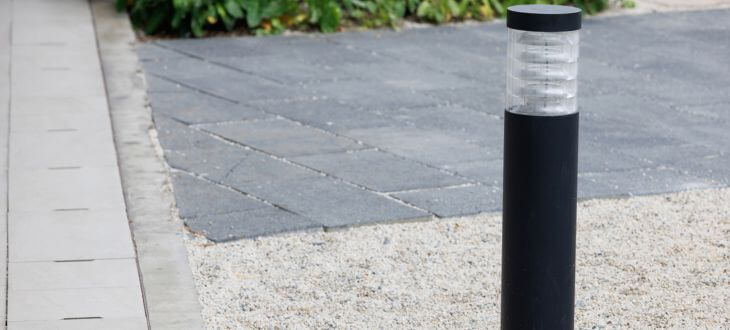
What Is a Bollard?
A bollard is a short, sturdy vertical post installed to manage traffic, deter vehicle intrusions, and protect people and property. They show up everywhere — outside storefronts, in parking lots, along sidewalks, and at the entrances to public buildings — often so seamlessly that most people don’t give them a second thought.
Bollards can be made from a range of materials including steel, concrete, cast iron, and even high-density plastic. They also come in several operational configurations:
- Fixed bollards: Permanently installed, ideal for long-term barriers
- Retractable (or telescoping) bollards: Can be raised or lowered to allow vehicle access when needed
- Removable bollards: Manually lifted out for temporary access
- Flexible bollards: Designed to bend on impact, primarily used for traffic guidance
Each type comes with its own price range and installation requirements, which we’ll cover in detail below.
Bollard Installation Cost by Type
The type of bollard you choose is the single biggest factor influencing your total bollard installation cost. Here’s what you can expect to pay per unit:
Fixed Bollards: $50 to $500 per bollard
Fixed bollards are the most common and affordable option. They’re embedded directly into the ground with concrete and are not designed to be moved. Because of their simplicity, they’re the easiest to install and carry the lowest labor costs. They work well for permanent perimeter protection around storefronts, parking lots, and pedestrian walkways.
On the lower end, you’ll find basic steel pipe bollards. On the higher end, you’ll find decorative options made from cast iron or architectural-grade steel that blend into the design of a building or streetscape.
Flexible Bollards: $100 to $300 per bollard
Flexible or “delineator” bollards are made from high-density polyethylene or rubber and are designed to flex on impact rather than stop a vehicle. They’re primarily used for traffic guidance — marking lane boundaries, protecting bike lanes, or separating pedestrian zones from vehicle traffic. Installation is simpler and faster, which keeps labor costs relatively low.
Retractable Bollards: $500 to $3,000+ per bollard
Retractable bollards (also called rising or telescoping bollards) are the premium option. They can be lowered into the ground to allow vehicle access and raised when access needs to be restricted. Manual retractable bollards sit at the lower end of the range, while hydraulic or automatic versions with electronic controls can push well past $3,000 per unit — not including installation labor.
These are a popular choice for loading docks, hotel entrances, event venues, and any location that needs flexible vehicle access control.
High-Security and Anti-Ram Bollards: $1,000 to $10,000+ per bollard
For locations requiring certified crash-rated protection — government buildings, embassies, utilities infrastructure, or high-value retail — anti-ram bollards are engineered to stop vehicles traveling at speed. These carry ASTM or DOS K-ratings and must be installed with reinforced concrete footings. The bollards themselves are more expensive, and so is the installation.
Bollard Installation Labor Costs
Even a straightforward bollard installation requires professional contractors. Expect to pay $50 to $150 per hour for labor, though rates vary by region and project complexity.
A simple fixed bollard installation might take 1–2 hours per post, while a retractable or automatic system can take significantly longer due to electrical work, hydraulic connections, and more extensive excavation.
For a row of 10 fixed bollards, you might spend $500 to $1,500 in labor alone. For a complex retractable system with automation, labor costs can rival or exceed the cost of the bollards themselves.
Additional Factors That Influence Bollard Installation Cost
Beyond the bollard type and labor rate, several other variables will affect your total project cost.
1. Site Preparation
Before any bollard goes in the ground, the site needs to be assessed and prepared. This can include:
- Excavation — Digging the hole or trench for the bollard footing. Rocky soil, concrete surfaces, or tight urban spaces increase this cost.
- Concrete removal — If you’re installing bollards in an existing paved area, the existing surface needs to be cut and broken up first.
- Utility location — Any reputable contractor will check for underground utilities (gas, water, electrical) before digging. This step adds time but is non-negotiable for safety.
Site prep costs vary widely but can add $100 to $500 or more per bollard in challenging conditions.
2. Concrete and Base Materials
Most fixed and retractable bollards require a concrete footing to ensure stability. The cost of concrete, rebar, and other base materials is typically factored into the contractor’s quote but is worth asking about explicitly. For standard installations, expect to add $20 to $100 per bollard in materials costs.
3. Quantity
Like most construction projects, bollard installations benefit from economies of scale. Installing 20 bollards at once will cost significantly less per unit than installing two. If you’re planning a larger project, getting multiple bollards installed in a single mobilization can reduce your overall bollard installation cost considerably.
4. Geographic Location
Labor costs vary significantly by region. Installation in a major metropolitan area will generally cost more than the same project in a rural market. Material delivery costs can also fluctuate depending on your distance from suppliers.
5. Customization and Aesthetics
Standard steel pipe bollards are functional but plain. Many property owners opt for decorative bollards — cast iron posts with ornamental caps, powder-coated finishes in custom colors, or bollards designed to match a building’s architectural style. Custom aesthetics can significantly increase the unit price but also add long-term value to the property’s appearance.
6. Permits
Depending on your municipality, bollard installation may require a permit, especially for work that involves cutting into public sidewalks or roadways. Permit costs are typically modest ($50–$200), but the process can add time to your project timeline.
7. Electrical and Automation Components
Automatic retractable bollards require electrical connections, control panels, and sometimes loop detectors or access card readers. Electrical work adds cost and must be performed by a licensed electrician. Budget an additional $500 to $2,000 or more for electrical components in automated systems.
Are Bollards a Cost-Effective Investment?
The short answer: yes — when you weigh the bollard installation cost against what you’re protecting.
- Durability: Steel and concrete bollards are built to last decades with minimal maintenance. Unlike security cameras or alarm systems, they require no ongoing software updates, subscriptions, or battery replacements.
- Property damage prevention: A single ram-raid incident can result in tens of thousands of dollars in property damage, lost inventory, and business downtime. A row of bollards can eliminate that risk entirely.
- Liability reduction: Bollards that protect pedestrians from accidental vehicle incursions can significantly reduce liability exposure for property owners. That alone can justify the installation cost.
- Insurance savings: Many insurers offer reduced premiums for properties with passive vehicle security measures like bollards. Check with your insurance provider — the savings can offset a meaningful portion of the installation cost over time.
- Versatility: The same bollards that protect your storefront can guide traffic, prevent illegal parking, and improve the overall look of your property.
What Does a Bollard Installation Project Actually Cost?
To put the numbers together, here are a few realistic project scenarios:
| Scenario | Bollards | Estimated Total Cost |
|---|---|---|
| Small retail storefront (fixed steel) | 4–6 bollards | $800 – $3,500 |
| Parking lot perimeter | 15–20 bollards | $2,500 – $10,000 |
| Retractable system for loading dock | 2–4 bollards | $3,000 – $12,000 |
| High-security anti-ram installation | 6–10 bollards | $10,000 – $50,000+ |
These ranges account for materials, labor, and standard site preparation. Complex sites, custom finishes, or automated systems will push costs toward the higher end.
Final Thoughts on Bollard Installation Cost
Bollards are one of the most reliable, low-maintenance security and safety investments available to property owners and municipalities. The bollard installation cost varies based on type, quantity, location, and site conditions — but in almost every scenario, the long-term protection they provide outweighs the upfront expense.
If you’re planning a bollard installation project, the best first step is getting a quote from a qualified contractor who can assess your specific site and recommend the right bollard type for your needs.
Get Quality Steel for Your Bollard Project from Tampa Steel & Supply
Need steel pipe bollards? Tampa Steel & Supply carries a wide selection of quality steel products and offers professional metal processing services to meet your project specifications.
Call Tampa Steel & Supply at (813) 241-2801 or inquire about a custom quote online.