
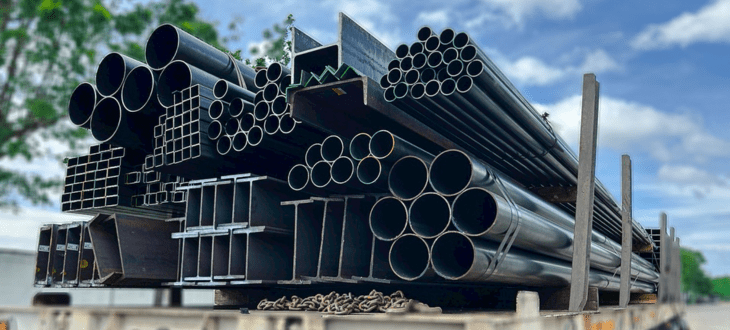
Knowing how much your steel weighs is essential for accurate pricing, freight planning, safe handling, and structural design. Whether you’re ordering steel plate, sheet, tube, pipe, beams, or angles, understanding steel weight helps you avoid delays, unexpected shipping costs, and equipment issues.
This guide explains how to calculate steel weight, provides standard formulas by shape, and includes quick-reference weights for common sizes, so you can estimate material needs with confidence.
Why Steel Weight Matters
Steel is bought, sold, shipped, and lifted based on weight. Even small miscalculations can create big problems on a job.
Steel weight affects:
- Material cost (steel is sold by the pound or ton)
- Freight and delivery charges
- Crane, forklift, and trailer capacity
- Structural load calculations
- Jobsite safety and compliance
Knowing the weight before you order helps prevent costly mistakes.
Steel Density Used for Calculations
Most structural and carbon steel uses this industry-standard density:
- Steel density = 490 pounds per cubic foot
- Steel density = 0.283 pounds per cubic inch
All formulas in this guide use this standard value.
Steel Weight Formulas by Shape
Steel Plate and Sheet Weight
Steel plate and sheet are flat products measured by thickness, width, and length.
Formula:
Weight in pounds = Thickness (inches) × Width (inches) × Length (inches) × 0.283
Example:
A steel plate that is 1/4 inch thick, 48 inches wide, and 96 inches long: 0.25 × 48 × 96 × 0.283 = approximately 326 pounds.
Steel Pipe and Round Tube Weight
Round steel is measured by its outside diameter (OD) and wall thickness.
Formula:
Weight per foot = (OD² − ID²) × 0.02466
Where: Inside diameter (ID) = OD − (2 × wall thickness)
Example:
A 2-inch OD pipe with a 0.25-inch wall: Inside diameter = 2 − (2 × 0.25) = 1.5 inches. (2² − 1.5²) × 0.02466 × 12 = about 2 pounds per foot.
Square and Rectangular Steel Tube Weight
Formula:
Weight per foot = (Outer area − Inner area) × 0.283 × 12
Example:
A 2″ × 2″ tube with 0.125″ wall thickness: Outer area = 4; Inner area = 1.75 × 1.75 = 3.06. (4 − 3.06) × 0.283 × 12 = approximately 3.2 pounds per foot.
Steel Beam Weight
Steel beams are sold by their weight per foot, which is included in the product name.
Example:
A beam labeled W12×26 means:
- 12 inches deep
- 26 pounds per foot
A 20-foot beam would weigh: 26 × 20 = 520 pounds.
Steel Angle Weight
Formula:
Weight per foot = (Leg 1 + Leg 2 − Thickness) × Thickness × 0.283 × 12
This formula works for equal-leg and unequal-leg angle iron.
Quick Reference: Common Steel Weights
These are approximate weights used for planning and estimating:
- A 1/4-inch thick 4-foot by 8-foot steel plate weighs about 326 pounds
- A 1/2-inch thick 4-foot by 8-foot steel plate weighs about 652 pounds
- A 16-gauge 4-foot by 8-foot steel sheet weighs about 77 pounds
- A 2-inch by 2-inch square tube with 1/8-inch wall weighs about 3.2 pounds per foot
- A 2-inch Schedule 40 steel pipe weighs about 2.6 pounds per foot
- A W6×12 beam weighs 12 pounds per foot
- A W12×26 beam weighs 26 pounds per foot
Actual weight may vary slightly due to mill tolerances.
How Steel Weight Impacts Cost and Shipping
Material Cost
Steel is priced by weight. If your project needs 5,000 pounds instead of 4,500, your material cost increases immediately.
Freight and Delivery
Shipping companies charge based on total weight, length of material, and load classification. Incorrect weight estimates can lead to delivery delays, reclassification fees, or additional charges.
Handling and Safety
Forklifts, cranes, racks, and trailers all have rated capacities. Underestimating weight can cause equipment overload, OSHA violations, and serious safety risks.
Why Mill Tolerances Matter
Steel is manufactured within thickness and weight tolerances, meaning actual material may weigh slightly more or less than theoretical calculations. Always confirm certified material specs, actual wall thickness, beam weight per foot, and bundle or skid weight. This is especially important for large orders, structural steel, and crane lifts.
Common Reasons to Use a Steel Weight Calculator
- Estimating job costs
- Ordering raw material
- Scheduling freight and flatbeds
- Planning crane picks
- Designing load-bearing structures
- Avoiding over-ordering or under-ordering
Need Help Calculating Your Steel Order?
Whether you’re ordering a single sheet or an entire truckload, Tampa Steel & Supply can help you calculate accurate steel weights, freight costs, and material quantities before you buy. Our team works with fabricators, contractors, and builders across Florida every day — and we’ll make sure you get the right steel, at the right weight, at the right price.
Request a Quote Online or Call Tampa Steel & Supply at (813) 241-2801.