
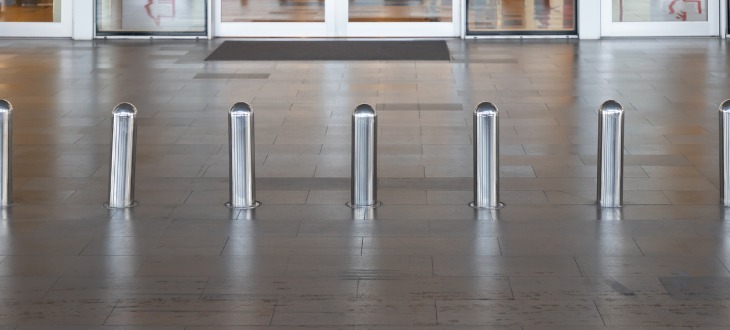
When designing a site for safety, aesthetics, and function, one question is often overlooked until it becomes critical: Where should bollards be placed? Strategic placement is the difference between a minor “fender bender” and a catastrophic structural collision.
Whether you are planning a retail storefront, an urban sidewalk, or an industrial loading dock, understanding the “where” and “how” of bollard placement is essential. This guide explores best practices for spacing and location to help you achieve a secure, professional site design.
Types of Bollard Installations
Before mapping out your site, you must choose an installation method that matches your security needs. For more details on these options, view our guide on Types of Bollards.
- Embedded (Fixed): Permanent posts deep-set in concrete. These provide maximum impact resistance for high-risk areas.
- Surface-Mounted: Bolted to existing concrete. Ideal for visual boundaries and light-duty traffic guidance.
- Removable & Retractable: Posts that can be lowered or moved to allow temporary vehicle access to service roads or event spaces.
- Decorative: Enhanced aesthetic designs that provide a basic level of protection while complementing local architecture.
How Far Apart Should Bollards Be Placed?
The effectiveness of a bollard system relies entirely on the gap between the posts. You need a “Goldilocks” distance: tight enough to stop a car, but wide enough for people.
The Spacing Requirements
- To Stop Vehicles: To prevent a standard passenger vehicle from passing through, bollards should be spaced no more than 5 feet apart (measured center-to-center).
- For Pedestrians & ADA Compliance: To remain accessible for wheelchairs, strollers, and pedestrians, you must maintain a clear path of at least 3 feet (36 inches) between the posts.
- Local Compliance: Always verify setbacks and placement requirements with Tampa or Hillsborough County building codes before installation to ensure project legality and adherence to local safety ordinances.
Bollard Placement and Spacing by Location
Effective placement depends on balancing safety with accessibility. Below are the key considerations for different environments.
1. Storefront Protection
Retail entrances are vulnerable to both accidental “pedal errors” and intentional vehicle intrusions.
- Placement: Position bollards in front of all pedestrian entry points accessible from drive lanes.
- Distance: They should be close enough to the curb to stop a vehicle but far enough to allow foot traffic—typically 3 to 5 feet from the entrance.
- Security Tip: For maximum security, use steel pipe bollards filled with concrete.
2. Sidewalks and Pedestrian Safety
In urban centers, bollards define the boundary between heavy traffic and human life.
- Placement: Focus on intersections, crosswalks, and transit stops where vehicles are most likely to mount the curb.
- Protection: Use bollards to shield outdoor seating areas and pedestrian plazas from surrounding roadways.
3. Asset and Infrastructure Protection
Critical utilities like HVAC systems, generators, and electrical transformers are often located near parking lots or service alleys.
- Placement: Create a perimeter around mechanical systems and vulnerable corners of parking garages.
- Industrial Use: In warehouses, place high-impact steel pipe bollards along loading dock edges to protect against reversing delivery trucks and forklift traffic.
General Guidelines for Professional Placement
To ensure your project meets safety standards, keep these four universal principles in mind:
- Sightlines: Bollards should never obstruct a driver’s view of oncoming traffic or pedestrians.
- Uniformity: Maintain consistent spacing (typically 4 to 5 feet) to avoid confusion and provide a clean visual rhythm.
- Visibility: Use high-visibility yellow sleeves or reflective strips to ensure drivers can see the barriers in low-light conditions.
- Coordination: Align bollards with existing lighting and signage to reduce visual clutter and improve site aesthetics.
Secure Your Site with Tampa Steel & Supply
Choosing the right location is only half the battle, you also need high-quality materials. At Tampa Steel & Supply, we stock an extensive inventory of prime and surplus steel products ready to be customized for your specific site requirements.
Whether you need a simple security barrier or a specialized solution involving our metal processing and fabrication services, our team is here to support your project from the initial planning stages to final completion.
Ready to secure your property? Inquire today for a custom quote or call us at (813) 241-2801 to discuss your project with our expert staff.