
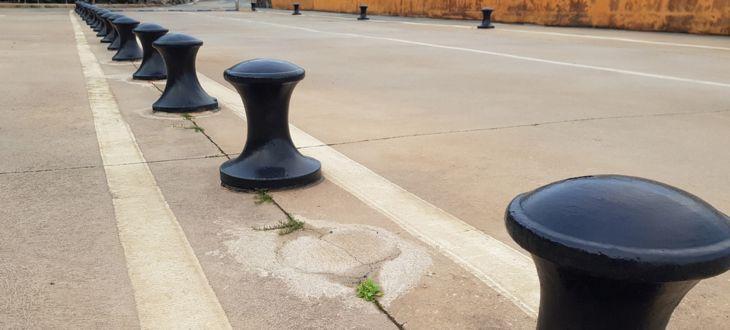
What Are Bollards and Why Do They Matter?
A bollard is a short, sturdy vertical post, typically made from steel, installed in the ground to control or block vehicle traffic. You’ll see them outside gas stations, retail entrances, warehouses, and parking structures throughout Florida. Their job is to keep vehicles away from buildings, pedestrians, utility lines, and equipment while still allowing people to move through freely.
Bollards matter because they prevent costly property damage, reduce liability from vehicle related accidents, and in many cases help properties meet local accessibility and safety codes. But a bollard is only part of the equation. The distance between each post determines whether the installation actually does its job.
Why Bollard Spacing Is So Important
Spacing isn’t just a design detail, it’s a functional requirement. Space bollards too far apart and a vehicle can drive right through the gap, defeating the entire purpose of the installation. Space them too close together and you risk violating accessibility standards, blocking pedestrian flow, or creating an unnecessarily expensive installation with more posts than the site actually needs.
The right spacing depends on what the bollards are meant to accomplish. A row of decorative bollards guiding foot traffic through a plaza has very different requirements than a security barrier designed to stop a vehicle from ramming a storefront. Getting this wrong isn’t just an aesthetic issue, it can create real safety and liability problems for a property owner.
How Far Apart Should Bollards Be Placed?
Most bollards should be spaced 3 to 5 feet apart on center, measured from the center of one post to the center of the next. This range keeps standard passenger vehicles from passing through while still meeting the ADA’s minimum 36 inch clear width requirement for wheelchairs and mobility devices. The exact spacing within that range depends on the site’s specific security needs, foot traffic patterns, and local code requirements.
Spacing by Use Case
Pedestrian Safety and ADA Accessibility
For areas focused primarily on guiding foot traffic, such as sidewalks, plazas, and building entrances, spacing typically falls toward the wider end of the range. The Americans with Disabilities Act requires a minimum clear width of 36 inches between bollards to allow safe passage for wheelchairs, strollers, and other mobility aids. Most designers aim for 4 to 5 feet on center to comfortably clear that minimum while still discouraging vehicles from driving through.
Storefront and Property Protection
For bollards installed to protect a building’s glass storefront, HVAC units, or gas meters from accidental vehicle impact, the standard 3 to 5 foot on center spacing generally applies. This range is narrow enough to block the width of a typical passenger vehicle, which measures roughly 5.5 to 6 feet at the track, while remaining wide enough for pedestrian movement and cost efficient installation.
High Security and Anti Ram Applications
In higher risk locations, such as government buildings, banks, or critical infrastructure sites, spacing is often tightened to 3 to 4 feet on center. Closer spacing reduces the chance that a vehicle can strike a gap at an angle and squeeze through, which matters most for crash rated bollard systems designed to stop a vehicle’s momentum entirely rather than simply mark a boundary.
Parking Lots and Loading Docks
Inside warehouses and around loading docks, bollards are often used to protect racking, equipment, and building corners from forklifts and delivery trucks rather than passenger vehicles. Spacing here tends to be more flexible, commonly 4 to 6 feet apart, since the goal is protecting specific pinch points rather than creating a continuous barrier. Property owners should also account for a setback of about 1.5 feet from the curb in adjacent parking spaces, which gives room for car doors to open fully.
Decorative and Low Traffic Areas
For bollards used mainly for aesthetics or gentle traffic guidance, such as in front of a retail shopping center with light vehicle exposure, spacing can extend to 5 or 6 feet in low risk settings. These installations still need to stay within a range that discourages vehicles from treating the gap as a driveway, but the priority shifts more toward visual flow and pedestrian comfort than hard security.
Practical Considerations
- Measure from the outer edge, not just the post. If you’re adding decorative sleeves or covers, measure clearance from the outermost surface, not the bare pipe, since covers can reduce the usable gap.
- Account for approach angle. A gap that looks secure head on can still be vulnerable to a vehicle approaching at an angle, so consider realistic traffic patterns during layout, not just straight line distances.
- Check local codes before finalizing your plan. Spacing recommendations vary by jurisdiction and application, and some municipalities set their own requirements on top of ADA minimums.
- Match spacing to bollard diameter. A 4 foot on center layout with 6 inch diameter posts leaves a different clear width than the same layout with 10 inch posts, so factor post size into your spacing math from the start.
If you’re weighing fixed versus removable bollards or trying to figure out which type best fits your site, our guide to different types of bollards and their uses walks through the options in more detail.
Final Thoughts
Bollard spacing is where planning meets practicality. The 3 to 5 foot on center range covers most commercial and residential applications, but the right number for your property depends on whether you’re prioritizing pedestrian accessibility, vehicle exclusion, or a mix of both. For a deeper look at how steel pipe bollards perform once they’re in the ground, check out our guide on how steel pipe bollards work.
For official accessibility guidance, the U.S. Access Board’s 2010 ADA Standards for Accessible Design outline the specific clearance requirements referenced throughout this guide.
If your project calls for enhanced security rather than general traffic guidance, our security bollards guide breaks down crash rated options and placement considerations for higher risk sites.
If you’re planning a bollard installation and need quality steel pipe cut to size, Tampa Steel & Supply can help you source the right diameter and length for your project.