
Choosing a reinforcement material is a long-term decision, and durability is often the deciding factor. Fiber Reinforced Polymer, or FRP, rebar has become a popular alternative to traditional steel rebar precisely because of how well it holds up over time, especially in harsh or corrosive environments where steel struggles.
What Is FRP Rebar?
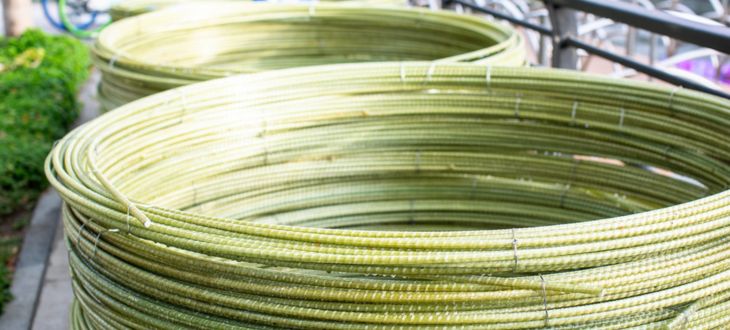
FRP (fiber-reinforced polymer) rebar is a lightweight, non-metallic composite bar made from high-tensile glass or carbon fibers bound in a durable resin matrix.
Unlike traditional steel rebar, FRP does not rust, spall, or corrode over time. It is manufactured to match standard imperial rebar designations, making it simple for contractors to source the exact sizing required for project specs:
- #3 FRP Rebar (3/8″ Nominal Diameter): Ideal for light commercial slabs, driveways, walkway reinforcement, and temperature mesh replacement.
- #4 FRP Rebar (1/2″ Nominal Diameter): The standard workhorse size for structural concrete slabs, footings, retaining walls, and pool decks.
- #5 FRP Rebar (5/8″ Nominal Diameter): Used for heavy structural loads, seawalls, bridge decks, and heavy industrial foundations.
This total resistance to oxidation makes FRP rebar an ideal choice for high-moisture and coastal environments, including seawalls, parking garages, water treatment plants, and marine infrastructure.
How Long Does FRP Rebar Last?
FRP rebar has a service life of over 100 years in typical concrete environments, according to accelerated aging tests and long-term field studies. That’s largely due to its resistance to corrosion, the primary factor that limits the lifespan of traditional steel rebar. In harsh, corrosive conditions where steel would typically fail within 20 to 30 years, FRP rebar can maintain its structural performance well beyond a standard building’s design life.
Factors That Impact FRP Rebar’s Lifespan
Environmental Exposure
FRP rebar’s biggest advantage shows up in aggressive environments. Because it doesn’t corrode, it performs consistently in coastal areas, water treatment facilities, and structures exposed to de-icing salts, conditions that would significantly shorten the service life of steel reinforcement. Field data from GFRP-reinforced infrastructure built decades ago continues to show strong structural performance with no corrosion-related issues.
Alkaline and Moisture Exposure
While FRP resists corrosion, it isn’t entirely immune to degradation. Prolonged exposure to highly alkaline concrete pore water, combined with moisture, can gradually affect the resin matrix over very long timeframes. This is a much slower process than steel corrosion, and manufacturers account for it through environmental reduction factors built into design standards, but it’s still a variable worth understanding for specialized or extreme applications.
UV Exposure Before Installation
FRP rebar that sits exposed to direct sunlight for extended periods before being embedded in concrete can experience some surface degradation from UV rays. Once installed and covered by concrete, this stops being a factor, which is why proper storage and timely installation matter during the construction phase.
Design and Engineering Standards
Lifespan isn’t just about the material itself, it’s also about how it’s specified and installed. Design codes such as ACI 440 provide guidelines for serviceability, deflection control, and long-term performance when using FRP rebar. Projects that follow these established standards are far more likely to achieve the material’s full expected service life than those that don’t account for FRP’s different mechanical properties compared to steel.
Manufacturing Quality
Not all FRP rebar is produced to the same standard. Bar quality depends on fiber content, resin type, and manufacturing consistency during the pultrusion process. Products that are ICC-ES evaluated and certified have been tested against rigorous industry benchmarks, giving engineers and contractors confidence that the material will perform as expected over its full design life.
Application and Load Conditions
How the rebar is used also plays a role. FRP performs exceptionally well under tensile loads and repeated loading cycles, which contributes to strong fatigue resistance in applications like bridge decks and industrial floors. However, because it has a lower shear strength than steel, projects need to be engineered accordingly to avoid conditions that could shorten its effective performance over time.
Why This Matters for Your Project
For construction throughout the Tampa Bay area, local ground conditions pose a constant threat to concrete integrity. High-salinity soil, elevated coastal water tables, and brackish tidal waters continuously push moisture into buried concrete.
When traditional steel rebar oxidizes, it expands up to six times its original volume—cracking the surrounding concrete from within (known as spalling) and causing unsightly, permanent rust-staining along seawalls, foundations, and exposed slabs.
By replacing steel with FRP rebar, you eliminate corrosion-related issues entirely:
- No Spalling or Cracking: FRP cannot rust or expand, protecting coastal seawalls, pool decks, and foundations from internal structural failure.
- Eliminates Rust-Staining: Keeps high-visibility concrete surfaces, retaining walls, and parking structures clean and free of red iron oxide runoff.
- Lower Lifecycle Costs: While traditional steel requires ongoing chemical sealing, cathodic protection, and frequent patch repairs, FRP-reinforced structures require virtually zero maintenance over a 50- to 70-year lifespan.
For contractors and project owners in Tampa’s high-moisture environment, choosing FRP rebar turns a short-term construction budget into a long-term investment in structural durability.
For more detail on how FRP rebar compares to steel across cost, strength, and long-term performance, the American Composites Manufacturers Association offers an in-depth technical overview.
Final Thoughts
FRP rebar’s exceptional lifespan comes down to one core advantage: it doesn’t corrode. That single property changes the durability equation for structures in coastal, marine, and chemically aggressive environments, where steel simply isn’t built to last as long. If you’re weighing FRP against traditional steel rebar for your next project, our comparison guide breaks down the key differences.
For a broader look at what FRP rebar is and how it’s made, check out our full overview.
Trust Tampa Steel & Supply for Your Next Project
Tampa Steel & Supply carries a comprehensive inventory of FRP rebar options engineered for the corrosion resistance and long-term durability covered throughout this guide. As a family- and veteran-owned business proudly serving the Tampa Bay area since 1983, our experienced team is here to help you select the ideal materials for a project built to last.
Inquire for a Custom Quote online today, or call Tampa Steel & Supply directly at (813) 241-2801.