
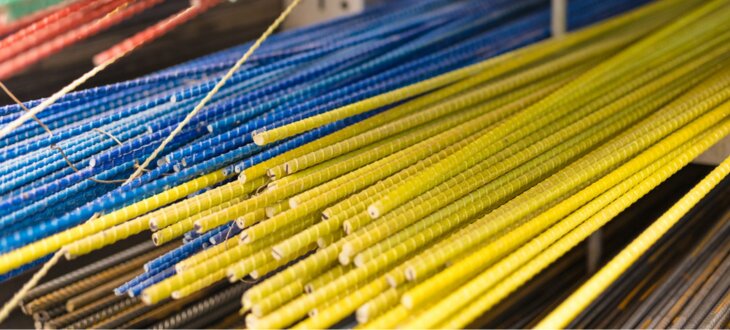
In the construction world, rust is the enemy. Traditionally, steel rebar has been the backbone of concrete, but in coastal or high-chemical environments, steel’s tendency to corrode can lead to structural failure. FRP (Fiber Reinforced Polymer) rebar has emerged as a high-tech solution to this age-old problem.
What is FRP Rebar?
FRP Rebar is a high-strength composite reinforcing bar made from glass fibers and polymer resin. By binding these incredibly strong fibers together with a resin matrix, manufacturers create a non-metallic reinforcement that is completely corrosion-resistant, non-conductive, and significantly lighter than traditional steel.
The Pros of FRP Rebar: Why Use It?
FRP rebar offers several transformative advantages, particularly for specialized infrastructure projects.
- Ultimate Corrosion Resistance: This is the #1 benefit for Tampa residents and those living near saltwater. Unlike carbon steel, FRP does not oxidize. It will not rust or degrade in marine environments, making it the premier choice for seawalls, docks, and pool decks where salt air quickly destroys traditional metal.
- Significantly Lightweight: FRP is roughly 75% lighter than steel while offering superior tensile strength. This makes it a game-changer for the DIYer; it is much easier for a single person to transport, carry, and install without the need for heavy machinery or a large crew.
- Non-Conductive and Non-Magnetic: Since it contains no metal, FRP is “transparent” to magnetic fields and electrical currents. It is a requirement for MRI rooms in hospitals and high-voltage power stations.
- Extreme Durability: According to the American Society of Civil Engineers (ASCE), composite materials like FRP can extend the lifespan of concrete structures to over 100 years by eliminating “concrete spalling” caused by rusting steel.
The Cons of FRP Rebar: What are the Trade-offs?
Despite its strengths, FRP is not a 1:1 replacement for steel in every scenario.
- Higher Initial Price: We acknowledge that there is a higher upfront cost compared to standard carbon steel. While it saves money over its lifetime through reduced maintenance, the initial investment per linear foot is more expensive.
- Field Bending Limitations: A critical factor to plan for is that FRP cannot be bent in the field. Unlike steel, which can be adjusted with a torch or a hickey bar on-site, FRP must be pre-fabricated or ordered to specific shapes and angles from the factory.
- Brittleness (Lack of Ductility): Steel is ductile—it bends before it breaks. FRP is brittle; it maintains its shape until it reaches its breaking point, at which it fails suddenly.
- Lower Shear Strength: FRP rebar has a lower resistance to “perpendicular” force compared to steel. This requires engineers to use specific design codes to ensure safety.
Common Questions About FRP Rebar
To help you decide if this material is right for your project, here are the most frequent questions answered by our experts.
1. Can you cut FRP rebar on-site?
Yes, but you cannot use a torch. FRP should be cut using a diamond-blade saw or an angle grinder. Because it is made of fiberglass, workers should always wear proper PPE, including gloves and a respirator, to avoid skin and lung irritation from fine glass dust.
2. Is FRP rebar cheaper than steel?
Initially, no. The material cost for FRP is often 15% to 25% higher than traditional black steel. However, when you factor in 75% lower shipping costs, faster installation, and the total removal of future maintenance/repair costs due to rust, FRP is often the most cost-effective lifecycle solution.
3. Does FRP rebar have a fire rating?
FRP has different fire characteristics than steel. While it doesn’t melt, the polymer resin can lose strength at high temperatures (typically starting around 400°F). In structures where high fire ratings are required, engineers typically use thicker concrete cover to protect the rebar.
Expert Reinforcement Solutions in Tampa
Whether your project calls for the tried-and-true strength of steel or the advanced protection of FRP, Tampa Steel & Supply has the inventory and expertise to guide you. As a family- and veteran-owned business, we are deeply committed to the strength of our local community. We treat every customer like a neighbor, ensuring you get the right materials to build structures that last for generations.
Build with confidence. Inquire today for a custom quote or visit our showroom to speak with a professional about your reinforcement needs.