
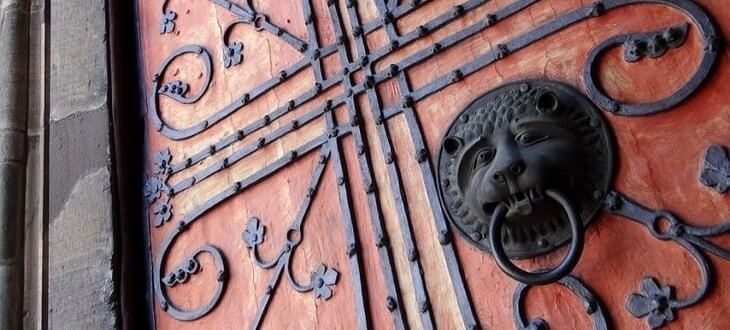
The next time you think you see a wrought iron gate on a structure less than 100 years old, think again; it’s probably mild steel!
Wrought iron is a crude alloy with a carbon content below 1%. It doesn’t meet today’s iron standards because it contains some of the slag that forms during the smelting process. Its low carbon content makes it malleable, fibrous, ductile, and very corrosion-resistant. These properties allow it to be forged, bent, and shaped easily without breaking or fracturing – its versatility has let it be used for weapons, construction, and ornamentation throughout the ages.
Wrought iron displaced bronze for tools and weaponry in the 200s BCE, as it was more readily available than copper and tin. Englishman Henry Cort’s “puddling” process, invented in 1784, allowed for its widespread large-scale manufacture. By the 1800s, it was used for structural beams, and it was not until the advent of the Bessemer process that steel replaced it.
As steel, cheaper and stronger, came into general use and more specialized alloys were developed, wrought iron slowly disappeared. Today, it survives only as a misnomer; though the name “wrought iron” is generically applied to ornamental metals, most such components are formed from mild steel.
Yet original pieces still remain. Many wrought iron gates and fences around the world are hundreds of years old, but still intact today. The slag in true wrought iron, which makes up about 2% of its structure, forms a surface film that protects it from pitting and oxidation.
So whenever you see filigreed metal, take a closer look. You might be seeing centuries-old ironwork… or plain old mild steel.