
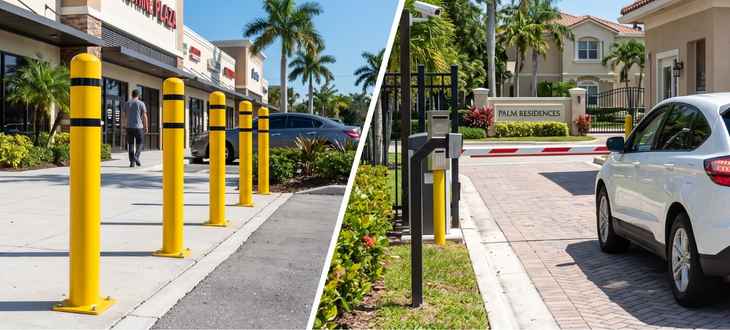
When it comes to controlling who and what drives onto a property, Florida business owners and property managers usually land on two options: bollards or barriers. Both protect people and buildings from vehicle-related damage, but they do it in very different ways and at very different costs. Choosing wrong can mean paying for automation you don’t need, or worse, leaving a building entrance without the protection it actually requires. This guide breaks down how bollards and barriers work, compares them head-to-head on price, installation, maintenance, and longevity, and helps you figure out which one, or which combination, is the better fit for your Tampa Bay property.
What Are Bollards and How Do They Work?
A bollard is a short, fixed vertical post—most commonly Schedule 40 or Schedule 80 heavy-wall steel pipe set in a concrete footing—that creates a permanent physical barrier against vehicles while still letting pedestrians walk through freely. Bollards are passive protection: once installed, they don’t move, don’t need power, and don’t require anyone to operate them. That simplicity is exactly what makes them so reliable.
Bollards come in several forms. Fixed bollards are permanently anchored and offer the strongest, lowest-maintenance protection. Removable bollards can be lifted out of a ground sleeve when full access is needed. Retractable bollards lower into the ground at the turn of a key or push of a button, giving some of the convenience of a barrier without the ongoing mechanical upkeep. Crash-rated bollards are engineered and tested to stop a vehicle at a specific speed and weight, which matters anywhere protecting people from an intentional or high-speed impact. For more detail on how these posts hold up once installed, see our guide to steel pipe bollards and the full list of pipe bollard benefits.
What Are Barriers and How Do They Work?
A barrier, in this context, refers to an active vehicle access control system: an arm gate, swing gate, sliding gate, or rising barrier that physically opens and closes to let approved vehicles through. Unlike a bollard, a barrier isn’t a passive obstacle, it’s a machine, usually run by a hydraulic or electric motor and triggered by a keypad, card reader, remote, ticket system, or intercom.
Barriers are built for situations where some vehicles need to get in and others don’t: a gated community, a paid parking garage, a secured loading dock, or a corporate campus with employee-only access. Because they open and close on demand, barriers manage traffic flow without anyone needing to physically move anything. Most commercial gate barriers feature heavy-duty 11-gauge steel housings to protect internal motors and electronics, but that convenience still comes with moving parts that require ongoing maintenance—especially in a Florida climate where heat, humidity, and salt air accelerate wear. Barriers are also frequently paired with bollards on either side of the gate opening, since a determined driver can otherwise simply steer around an open gate arm.
Bollards vs Barriers: Key Differences
The right choice usually comes down to four practical factors: price, installation, maintenance, and longevity. Here’s how they stack up, based on typical figures reported in this bollards vs. barriers breakdown:
| Factor | Bollards | Barriers |
|---|---|---|
| Price | $50–$500 per post (standard); $1,000–$10,000+ for crash-rated units | $3,000–$15,000+ per lane, including motor, controls, and access hardware |
| Installation | Set in a concrete footing in a day or two; no wiring or power needed | Requires excavation, conduit, electrical work, and controller setup; often multi-day |
| Maintenance | Essentially none for fixed posts; occasional repainting or cover replacement | Regular motor, sensor, and hardware servicing, more frequent in humid, salty coastal air |
| Longevity | Decades of service with no moving parts to fail | Typically 7–15 years before major components need replacement or upgrading |
| Power Dependence | None, works during a storm or power outage | Requires electricity; needs battery backup to function if power goes out |
Price
Bollards win decisively on upfront cost. A standard fixed steel pipe bollard typically runs $50 to $500 installed, while a crash-rated bollard built to stop a specific vehicle weight and speed can run $1,000 to $10,000 or more per unit for high-security applications. Barriers cost more across the board because you’re paying for a motor, controller, safety sensors, and often a card reader or ticket system on top of the gate arm itself. A single automated lane can run anywhere from $3,000 to $15,000 or more depending on the level of automation, and our own guide to bollard installation costs breaks the bollard side of that down further by type.
Installation
A fixed bollard installation is straightforward: dig a footing, set the post in concrete, let it cure. Most residential and light commercial jobs wrap up in a day. Barriers need conduit run for power and controls, a solid foundation for the motor housing, and configuration of the access system, whether that’s a keypad, remote, or vehicle loop detector. That typically stretches installation into a multi-day project and usually requires a licensed electrician.
Note: Before any ground excavation begins for either system, calling 811 (Sunshine 811 in Florida) or visiting sunshine811.com at least two business days in advance is mandatory to ensure underground utility lines are safely located and marked.
Maintenance
This is where the two diverge the most. A fixed bollard has no moving parts, so beyond an occasional repaint or a replacement cover after a bad day, it needs almost nothing. Barriers are mechanical systems, and Florida’s heat, humidity, and salt air are hard on motors, hinges, and electronics. Expect to budget for periodic servicing, sensor calibration, and eventually motor or control-board replacement, especially for barriers near the coast.
Longevity
A well-installed steel pipe bollard can last decades with essentially no degradation. Barriers have a shorter practical lifespan because their electrical and mechanical components wear out well before the physical gate structure does. One independent 10-year cost comparison of bollards and barriers found that most facilities plan to replace or significantly refurbish a barrier system every 7 to 15 years, sooner in tough coastal environments, while the bollards protecting the same property might still be original decades later.
Which Is Better for Your Property?
There’s no single right answer, it depends on what you’re protecting and who needs access.
Choose bollards when you need permanent, low-maintenance protection for a specific spot: a storefront, a building corner, a gas meter, a loading dock door, a pedestrian walkway, or a driveway where every vehicle should be kept out entirely. If your budget is tight or you want something that will still work during a hurricane-related power outage, bollards are the more dependable choice.
Choose barriers when you’re managing a flow of authorized and unauthorized vehicles at scale: a gated community entrance, a paid parking garage, an apartment complex, or a corporate lot where residents, employees, or paying customers need to come and go without a security guard opening a chain every time.
Most well-protected properties actually use both. Barriers control the drive lane at the entrance, while bollards protect the sidewalks, building corners, and utility equipment that a barrier alone can’t cover, since a determined or distracted driver can always go around an open gate arm.
Making the Right Choice for Your Tampa Bay Property
Florida adds a few extra variables to this decision. Salt air and humidity accelerate corrosion on unprotected metal and shorten the service life of motors and electronics, which tends to favor simple, static bollards for anything where automation isn’t strictly necessary. Hurricane season is also worth planning around: a motorized barrier without battery backup simply won’t function during a power outage, right when access control often matters most, while a fixed bollard works exactly the same whether the grid is up or down.
If you do need a barrier for access control, pairing it with properly spaced bollards along the rest of the entrance closes the gap a single-arm gate leaves open. To prevent vehicles from bypassing a barrier arm, adjacent bollards should follow the standard 3-foot to 5-foot spacing rule: set posts at least 3 feet (36 inches) apart to allow ADA pedestrian and wheelchair passage, but no more than 5 feet (60 inches) apart on-center to block cars and trucks from slipping past. Whichever direction fits your property, choosing the right material and installation approach up front will save you from repeat repairs down the road.
A Few Real-World Examples
A strip mall on a busy Tampa road usually gets more value from bollards than barriers: every customer is welcome, so there’s nothing to authorize, and the real risk is a distracted driver drifting into a storefront or gas meter. A gated community or a self-storage facility is the opposite case: access genuinely needs to be restricted to residents, tenants, or ticket holders, which calls for a barrier arm at the entrance.
A restaurant with a busy drive-through, a marina with a fuel dock, or an apartment complex with a leasing office all tend to land somewhere in between, and that’s exactly where the hybrid approach earns its keep: a barrier or keypad gate to manage who drives in, and bollards protecting the pump islands, dumpster corrals, and walkways that a gate was never designed to guard in the first place.
Trust Tampa Steel & Supply for Your Next Project
Tampa Steel & Supply is your trusted source for quality steel pipe bollards in the Tampa Bay area, offering pre-cut sizes ready for fast installation along with custom cutting services for unique site requirements. As a family- and veteran-owned business proudly serving Tampa Bay since 1983, our team is ready to help you choose the right diameter, length, or spacing for your project, bollards, barriers, or both.
Inquire for a Custom Quote online today, or call Tampa Steel & Supply at (813) 241-2801.