
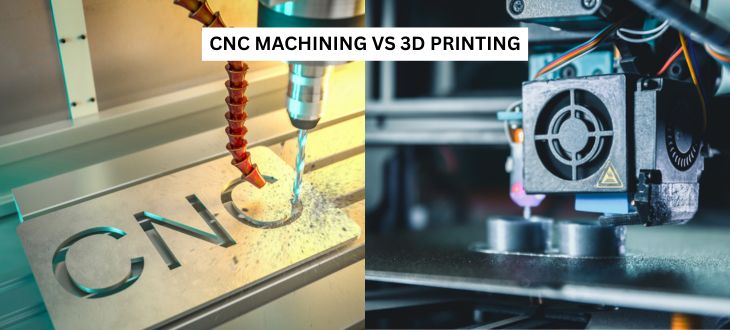
In modern manufacturing, the debate around CNC machining vs 3D printing isn’t about which technology is universally better—it’s about which is right for your stage of production.
One removes material (subtractive). The other builds it layer by layer (additive).
That single distinction drives everything—cost, strength, speed, and scalability.
Here’s how to choose.
At-a-Glance Comparison
| Feature | CNC Machining (Subtractive) | 3D Printing (Additive) |
| Best For | Mass production & final parts | Prototyping & one-offs |
| Material Strength | High (solid block) | Medium to low (layered) |
| Complexity | Limited by tool access | Nearly unlimited |
| Waste | Higher (chips/scrap) | Minimal |
| Surface Finish | Smooth / polished | Layered / textured |
| Setup Cost | Higher upfront | Low to none |
| Speed (Scaling) | Fast for large runs | Slower for volume |
1. CNC Machining: The Powerhouse
CNC machining is a subtractive process that cuts parts from solid blocks of metal or plastic using precision-controlled tools.
Because the material starts as a fully dense block, the final part retains its full strength and structural integrity.
Pros
- Unmatched strength and durability (ideal for steel and aluminum parts)
- Extreme precision (often within ±0.001”)
- Excellent surface finish straight off the machine
- Highly repeatable for medium to large production runs
- Broad material compatibility, including industrial-grade metals
Cons
- Higher setup cost (programming, tooling, fixturing)
- Material waste due to cutting away excess
- Limited geometry for complex internal features
Choose CNC Machining if: You need 50+ parts, structural integrity matters, or your components will be exposed to stress, load, or wear—like steel brackets, frames, or mechanical components.
2. 3D Printing: The Innovator
3D printing is an additive process that builds parts layer by layer from a digital model using plastics, resins, or metal powders.
Instead of removing material, it only uses what’s needed—making it incredibly efficient for design exploration.
Pros
- Total design freedom (internal channels, lattices, organic shapes)
- No tooling required, reducing upfront cost
- Fast prototyping and iteration
- Minimal material waste
- Ideal for custom or one-off parts
Cons
- Lower strength compared to machined parts
- Visible layer lines, often requiring post-processing
- Slower for high-volume production
- Limited material performance (depending on process)
Choose 3D Printing if: You’re developing a new product, testing multiple design variations, or need a custom part quickly without committing to production tooling.
Key Decision Factors
Cost & Volume
For 1–10 parts, 3D printing is usually more cost-effective. There’s no setup—you simply print.
For 100+ parts, CNC machining becomes more economical. Once programmed, machines produce parts rapidly and consistently.
Material Integrity
If your part needs to withstand load, pressure, or impact, CNC machining is the better choice.
Because it’s cut from a solid piece of metal, it avoids the weak points that can exist between layers in 3D printed parts.
Precision & Surface Finish
CNC machining produces parts that are dimensionally precise and visually refined right out of the machine.
3D printed parts often have a layered texture, similar to contour lines on a map, and may require sanding, coating, or polishing.
Design Complexity
This is where 3D printing shines.
If your design includes internal voids, intricate geometries, or organic shapes, additive manufacturing can achieve what CNC simply cannot.
The Hybrid Approach
In many real-world applications, the smartest strategy isn’t choosing between CNC machining vs 3D printing—it’s using both.
Phase 1: Use 3D printing to prototype and test multiple design iterations quickly.
Phase 2: Once the design is finalized, bring your 3D-printed prototypes into the TSS showroom to consult with our experts. We’ll help you bridge the gap between your plastic or resin model and the final product, discussing the best ways to transition to high-strength, production-ready steel using CNC machining.
This approach reduces risk, shortens development time, and ensures optimal performance in the final product.
Making the Right Choice for Your Project
When comparing CNC machining vs 3D printing, the decision comes down to your priorities:
- Choose CNC machining for strength, precision, and scalability
- Choose 3D printing for speed, flexibility, and rapid development
Both technologies play a critical role in modern manufacturing—and knowing when to use each gives you a major advantage.
Get the Right Materials for Your Next Project
Choosing the right manufacturing method is only half the battle—you also need high-quality materials to ensure long-lasting performance. At Tampa Steel & Supply, we stock an extensive inventory of prime and surplus steel products ready to be customized for your specific project requirements.
Whether you need a simple structural component or a specialized solution involving metal processing and fabrication, our team is here to support your project from initial planning to final completion.
Ready to secure your project with the right materials? Inquire today for a custom quote or call us at (813) 241-2801 to discuss your needs with our expert staff.