
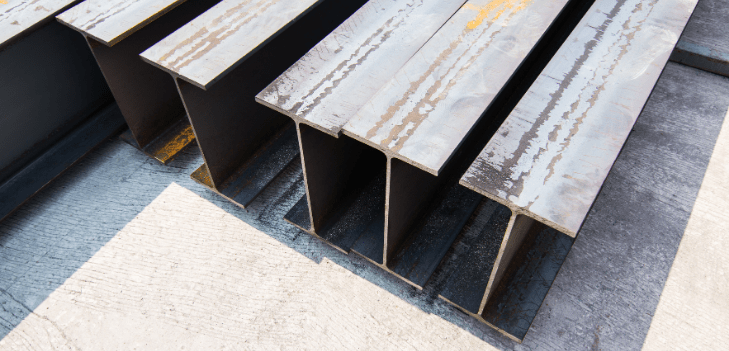
The question of the day! Do you know how H-beams and I-beams are used differently? Keep reading, and we will help you answer this important question. In the construction industry, many people still cannot explain this information properly. Steel beams are extremely important to understand because they support heavy loads.
What is an H-Beam?
H-beams are shaped like an H. H-beams are structural beams made of rolled steel. It is incredibly strong. It gets its name because it looks like a capital H over its cross-section.
What is an I-Beam?
An I-beam is shaped like an I. The I beam consists of two horizontal planes, known as flanges, connected by one vertical component, or the web. I-beam has tapered edges, and it gets its name from the fact that it looks like a capital I when you see it from its cross-section. With an I-beam, the height of the cross section is higher than the width of its flange.
Difference Between I-Beam and H-Beam
Weight
H-beam: The H-beam is often a lot heavier than the I-beam, which means it can take more force.
I-beam: In some buildings where weight and force on a wall may pose a structural issue, the I-beam may be preferable because it is often lighter.
Center Web
H-beam: An H-beam has a thicker center web, which means it is often stronger.
I-beam: An I-beam often has a thinner center web, which means it is often not able to take as much force as an H-beam.
Built-Up
H-beam: An H-beam can possibly be built up, which means it can be built up to any size or height.
I-beam: An I-beam can only be built up to the limit of the manufacturer’s milling equipment.
Spans
H-beam: H-beams can be used for spans up to 330 feet.
I-beam: An I-beam may be used for spans of between 33 and 100 feet.
Flanges
H-beam: H-beams have top and bottom flanges that stick out further from the web than the flanges on I-beams.
I-beam: I-beams have top and bottom flanges, and they are shorter and not as wide as H-beams.
Number of Pieces
H-beam: The H-beam appears to be one piece of metal, but it has a bevel where three pieces meet.
I-beam: An I-beam is not made by welding or riveting sheets of metal together and is only one piece of metal throughout.
What Are I-Beams Used For?
I-beams have a variety of important uses in the structural steel construction industry. They are often used as critical support trusses or the main framework in buildings. Steel I-beams ensure a structure’s integrity with relentless strength and support. The immense strength of I-beams reduces the need for numerous support structures, saving time and money and making the structure more stable. The versatility and dependability of I-beams make them a coveted resource for every builder.
Commonly termed an “I” beam because of its shape, beams provide great load-bearing support when used horizontally or standing as columns. I-beams are the preferred shape for structural steel construction because they are uniquely capable of handling a variety of loads. The shape of I-beams makes them excellent for unidirectional bending parallel to the web. The horizontal flanges resist bending, while the web resists shear stress.
Understanding the I-beam is a basic necessity for modern civil engineers and construction workers. Engineers use I-beams widely in construction, forming columns and beams of many different lengths, sizes, and specifications.
An I-beam is made by rolling or milling steel, which means the I-beam is often limited by the capacity or size of the milling equipment.
I-beams come in a variety of weights, section depths, flange widths, web thicknesses, and other specifications for different purposes. When ordering I-beams, buyers classify them by their material and dimensions. For example, an 11×20 I-beam would have a depth of 11 inches and a weight of 20 pounds per foot. Builders choose specific I-beam sizes based on the needs of the particular building. A builder has to take many factors into account, such as:
- The builder chooses an I-beam with a web thickness that won’t fail, buckle, or ripple under tension.
- The flanges are chosen to prevent buckling locally, sideways, or torsionally.
- The builder will choose a thickness to minimize the beam’s deformation.
- A certain mass and stiffness are selected to prevent vibrations in the building.
- The strength of the I-beam’s cross-section should accommodate the yield stress.
NOTE: Customers must fully evaluate every process and application in all respects, including suitability, compliance with applicable law, and non-infringement of others’ rights. Tampa Steel & Supply shall have no liability with respect thereto. The customer is solely responsible for determining the suitability and application of products offered by Tampa Steel & Supply. It is possible that certain information may be incomplete or incorrect in this blog.
Visit Tampa Steel & Supply for I-Beams
Do you need steel supplies? Look no further than the professionals at Tampa Steel and Supply. We stock an extensive list of steel products for whatever project you need to tackle. We’re proud to have served our customers for nearly four decades and are ready to assist you with your steel needs. Have questions? Give us a call today to learn more, or stop by our beautiful Tampa showroom.
Request a Quote Online
Or Call Tampa Steel & Supply at (813) 241-2801